 (that
is, the number of elements of ) is
(that
is, the number of elements of ) is  . Prove this by
(a) showing that there are at least symmetries, and
(b) showing that there are at most symmetries.
This is called a combinatorial (or counting) argument.
 , the
octahedral group) as did the dodecahedron and the icosahedron
(this is
, the
octahedral group) as did the dodecahedron and the icosahedron
(this is  , the icosahedral group). People made the
following conjectures:
, the icosahedral group). People made the
following conjectures:
Hamoon's second conjecture: The order of each of these symmetry groups is twice the number of edges.
Martin's conjecture: The order of each of these symmetry groups is the number of faces times the number of edges per face.
Both of these conjectures result in the following orders:  ,
,
 , and
, and  . Prove either of these conjectures, or at
least explain why you believe one of them.
. Prove either of these conjectures, or at
least explain why you believe one of them.
 is called abelian (or commutative) if
  for all elements
  . Prove that is abelian if and
only if
. Prove that is abelian if and
only if
(a)
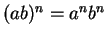 for all elements and for all
positive integers
for all elements and for all
positive integers 
(b)
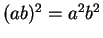 for all elements
(c)
 for all elements
(d)
 for all elements
(e)
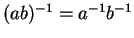 for all elements
(f)
for all elements and for all
negative integers
(g) (Harder!)
for all elements for  consecutive integers .
 consecutive
integers .
consecutive
integers .
is called cyclic if there is an element  so
that any element
so
that any element  may be written as
  for some
positive integer
for some
positive integer  . The element
  is called the generator
of .
is called the generator
of .
Prove that every cyclic group is abelian.
be a group of order . Prove that is cyclic (and
therefore abelian). Does your proof still work if  ? Can you
make a generalization of this statement (and proof)?
? Can you
make a generalization of this statement (and proof)?
be any finite group (this means that  is finite), and let
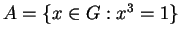 . Prove that
 is
odd.
is
odd.
(a) Prove that if is a group of even order then has an
element of order .
(b) We now know that if divides
 , then has
an element of order . Prove that if divides
, then has an element of order .
, then has
an element of order . Prove that if divides
, then has an element of order .
(c) Can you state a generalization of this result?
(d) Prove your generalization.