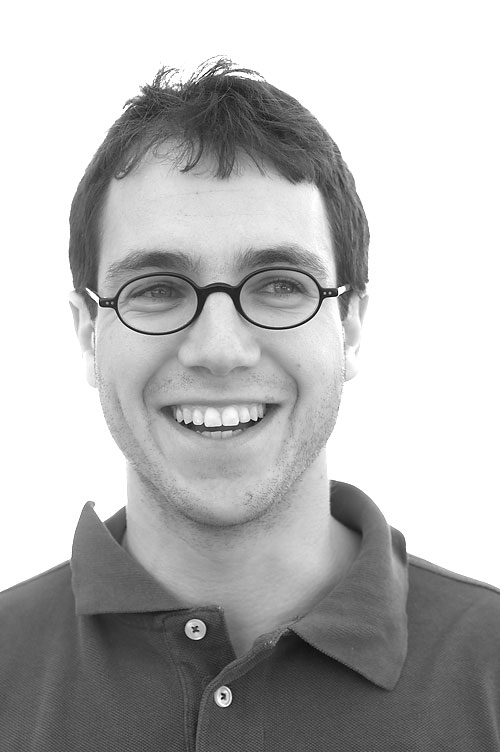
I am assistant professor at the University of Toronto. My office is Bahen 6110.
Since 2005, I have been an AIM five-year fellow. Previously, I held this fellowship at UC Berkeley and MIT.
My email is jkamnitz@math.toronto.edu.
CV Here is my CV.
Teaching
Seminars
Upcoming events
Blog Some friends and I have a mathematical blog, called the secret blogging seminar.
Students
Photos
Research
Crystals, coboundary categories, and the topology of the moduli space of real curves
Andre Henriques and I began by studying the relationship between the octahedron recurrence and the category of gl(n) crystals. That lead us to defining a commuter for the category of crystals for an arbitrary reductive Lie algebra. We found that this category is a coboundary category and that the cactus group acts on tensor products in coboundary categories. The classifying space for the cactus group is the moduli space of marked genus 0 real curves and so we were lead to studying the topology of this space with Pavel Etingof and Eric Rains. More recently, Peter Tingley and I have picked up the study of the commutor. First, we showed that the commutor admits an alternate definition using Kashiwara's involution. Later, we proved that the crystal commutor arising as q=0 limit of Drinfeld's unitarized R-matrix.
Crystals and coboundary categories with A. Henriques, Duke Math. J. 132 (2006), 191-216.
The octaheron recurrence and gl(n) crystals with A. Henriques, Adv. Math. 206 (2006), 211-249.
The cohomology ring of the moduli space of stable curves of genus 0 with marked points with P. Etingof, A. Henriques, and E. Rains, to appear in Annals of Mathematics.
A definition of the crystal commutor using Kashiwara's involution with P. Tingley, to appear in Journal of Algebraic Combinatorics.
The crystal commutor and Drinfeld's unitarized R-matrix with P. Tingley, to appear in Journal of Algebraic Combinatorics.
Mirkovic-Vilonen cycles and polytopes
By the geometric Satake Isomorphism, the Mirkovic-Vilonen cycles (certain subvarieties of the affine Grassmannian) give a basis for representations of complex reductive groups. In his thesis, Jared Anderson introduced MV polytopes and explained how they could be used to get some combinatorial objects out of MV cycles. In my thesis, I gave an explicit description of MV cycles and polytopes. This description used some combinatorics which had already been developed by Berenstein-Zelevinsky to describe Lusztig's canonical basis. In particular, this gives a combinatorial link between MV cycles and the canonical basis. I also studied the crystal structure on MV polytopes proving that the crystal operators coming from MV cycles (as defined by Braverman-Gaitsgory) and the crystal operators coming from the canonical basis coincide. Finally, I used this theory to construct a natural bijection between components of fibres of the convolution morphism for the affine Grassmannian of GL_n and combinatorial objects known as hives -- both objects count GL_n tensor product multiplicities.
Mirkovic-Vilonen cycles and polytopes , to appear in Annals of Mathematics.
The crystal structure on the set of Mirkovic-Vilonen polytopes , Adv. Math. 215 (2007), 66-93.
Hives and the fibres of the convolution morphism , Selecta Math. N.S. 13 no. 3 (2007), 483-496.
Knot homology via derived categories of coherent sheaves
Mikhail Khovanov has begun categorifying quantum knot invariants, such as the Jones polynomial. Sabin Cautis and I have proposed a program to accomplish this categorification using geometric representation theory. Specifically we study derived categories of coherent sheaves on varieties arising in the geometric Langlands programs. In our first paper, we study the case of sl(2) and recover the original Khovanov homology. In this case, our construction is related to that of Seidel-Smith by hyperKahler rotation. Our second paper deals with the case of sl(m) and the standard and dual representations. We conjecture that this recovers Khovanov-Rozansky homology. I also wrote a shorter paper advertising how one can develop as symplectic version of our theory generalizing the work of Seidel-Smith and Manolescu.
Knot homology via derived categories of coherent sheaves I, sl(2) case with S. Cautis, Duke Math. J. 142 no. 3 (2008), 511-588.
Knot homology via derived categories of coherent sheaves II, sl(m) case with S. Cautis, to appear in Inventiones Mathematicae.
The Beilinson-Drinfeld Grassmannian and symplectic knot homology.
Categorical sl(2) actions and equivalences of derived categories of coherent sheaves
Motivated by the above project, Sabin Cautis, Anthony Licata, and I have written a series of 3 papers applying the theory of categorical sl(2) actions to the construction of equivalences between derived categories of coherent sheaves. We developed a notion of "geometric categorical sl(2) action" and proved that such an action gives a strong categorical sl(2) action (which is almost the same as a 2-representation in the sense of Rouquier). We then extended a result of Chuang-Rouquier to prove that a strong categorical sl(2) action gives an equivalence of opposite weight categories. We applied these results to two related situations: cotangent bundles to Grassmannians and convolutions of smooth affine Schubert varieties for PSL(m).
Categorical geometric skew Howe duality with S. Cautis and A. Licata.
Coherent sheaves and categorical sl(2) actions with S. Cautis and A. Licata.
Derived equivalences for cotangent bundles to Grasssmannians via categorical sl(2) actions with S. Cautis and A. Licata.